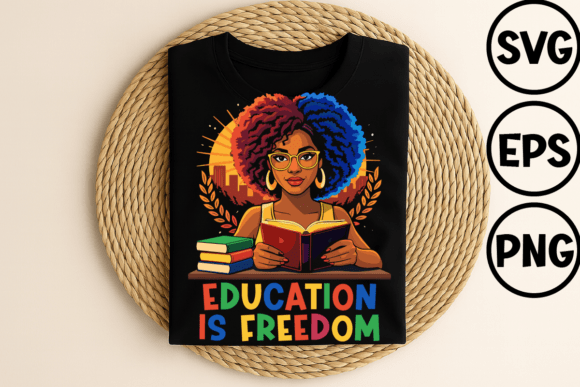
Education is Freedom: A Designer's Review
When I first opened the Education is Freedom design file, my initial reaction wasn't about the message itself, but about how it would translate from a digital screen to actual thread. As someone who has spent years evaluating embroidery files for both personal crafting and commercial boutique lines, I know that a great graphic doesn't always make a great machine embroidery design. The gap between a crisp vector image and a stitched reality can be wide, often determined by stitch density, lettering size, and fabric choice.
The Education is Freedom concept carries a weight that demands respect in its execution. It isn't just a slogan; it is a statement of social justice and bookish pride. For the designer looking to incorporate this into a T-Shirt Designs collection or a line of Graphics for apparel decorators, the challenge lies in balancing the boldness of the text with the softness required for wearable items like sweatshirts or baby clothes. My review focuses on how this specific design performs when moved from the computer to the hoop, offering a realistic look at its potential in real-world projects.
First Impressions and Design Personality
The visual personality of Education is Freedom suggests a project meant for the classroom, the library, or the home office. The layout appears clean, which is a strong indicator for successful digitization. In the world of machine embroidery, simplicity is often the key to longevity and clarity. When a design relies too heavily on intricate details or tiny serifs, the threads tend to crowd each other, leading to a muddy finish that loses the original intent.
What stands out immediately is the thematic fit. This isn't a generic floral pattern or an abstract shape; it is typographic art designed to convey a clear message. For a teacher, librarian, or anyone passionate about literacy, the mood is empowering yet grounded. It feels right at home on a heavy cotton sweatshirt where the texture of the fabric complements the weight of the words. However, the success of this embroidery file depends entirely on how the digitizer handled the transitions between letters and whether they utilized a mix of satin stitch for outlines and fill stitch for the body of the text effectively.
Real-World Application: From Tote Bag to Boutique
To truly understand the utility of this design, imagine a scenario where you are preparing inventory for a local craft fair or launching a new Etsy shop dedicated to educational gifts. You decide to create a custom embroidered tote bag for a "Back to School" sale. The Education is Freedom design seems perfect for this application.
However, as an experienced reviewer, I have to ask: does it work on a canvas tote? The answer lies in the stabilizer and the hoop size. If the design includes fine details that require a very small hoop, you might struggle to get enough tension on a thick canvas bag without puckering the material. Conversely, if the design is optimized for a larger area, it will pop beautifully against the neutral background of a tote, creating a high-value handmade product. The same logic applies to a baby onesie. Here, the design needs to be scaled down carefully. The phrase is powerful, but on a tiny garment, every millimeter counts. If the lettering is too dense, it could become uncomfortable against a baby's skin or lose definition after a few washes.
I also envision this design being used on kitchen towels or aprons for a "Book Lover's Gift" set. In these scenarios, the stitch density becomes critical. Kitchen linens are frequently washed, and designs that are too loose may unravel, while those that are too tight can cause the fabric to warp. The Education is Freedom concept shines here because it offers a conversation starter that customers will appreciate. It transforms a simple kitchen towel into a personalized gift that resonates with the recipient's values.
Where Caution is Required
While the design has broad appeal, there are specific areas where it requires careful handling. First, consider textured fabrics. If you attempt to embroider this on a fleece hoodie or a highly textured linen without proper stabilization, the running stitch or satin stitch may not lay flat, causing the text to look uneven. Similarly, stretchy fabrics like jersey t-shirts present a risk. Without a cut-away stabilizer to support the stitches, the design might distort over time, especially around the curves of the shoulder or sleeve.
Dark fabrics also demand attention. If the design relies on light-colored threads for contrast, ensure that the underlay is sufficient to prevent the dark fabric from showing through the stitching. On curved surfaces like caps, the design must be digitized specifically for the curvature of the brim. A flat design placed on a curved hat can result in the top of the letters stretching and the bottom bunching up. Always verify the hoop size compatibility before committing to a production run.
Visual Appeal and Customer Trust
In the competitive landscape of online marketplaces, the quality of your embroidery speaks volumes about your brand. A sloppy finished product can erode customer trust instantly, regardless of how meaningful the message is. The Education is Freedom design, when executed well, signals professionalism. It shows that you care about the details, which translates to higher perceived value for the buyer.
Customers buying into the "Social Justice Bookish" theme are looking for authenticity. They want to see a design that looks intentional and polished. If the thread colors chosen clash or if the stitch density is inconsistent, the message gets lost. A clean, crisp execution of this design on a high-quality sweatshirt or tote bag creates a sense of pride for the wearer. It becomes more than just clothing; it becomes a badge of identity.
For Etsy sellers and small shop owners, the versatility of this design allows for diverse marketing angles. You can use it for holiday gifts, wedding favors for teachers, or even corporate branding for libraries. The ability to adapt the design across different mediums—from embroidered patches to printable mockups—is a significant asset. It allows you to test the waters with minimal investment before scaling up production.
Practical Notes for the Embroidery Designer
Before you start stitching, there are several technical steps you must take to ensure success. First and foremost, test the design on scrap fabric that matches your final product in terms of weight and texture. This helps you gauge how the stabilizer interacts with the material and reveals any potential issues with thread tension or pull-in.
Review the stitch density closely. High-density areas can lead to needle breakage or skipped stitches, particularly on smaller machines. Ensure that the file includes appropriate underlay stitches to anchor the design firmly. If the design is intended for commercial use, double-check the licensing terms included with the download. Some digital embroidery files come with restrictions on how many finished units you can sell, while others allow unlimited commercial use.
Also, consider the thread colors. While the file might include suggestions, the best results often come from testing different thread brands to find the right sheen and color depth. Black thread on a black shirt, for example, requires a specific technique to be visible, often involving a contrasting outline or a metallic thread. Finally, inspect the small details. Are the corners sharp? Is the spacing consistent? These micro-details define the difference between a mass-produced item and a bespoke creation.
Ultimately, the Education is Freedom design offers a compelling opportunity for creators who value meaningful messaging in their craft. By approaching it with a critical eye toward technical execution and fabric compatibility, you can turn a simple digital file into a cherished piece of wearable art. Whether you are decorating a single gift for a loved one or building a full line of custom apparel, the key lies in respecting the medium and the message alike.